Today’s holidays: Sukkoth (Judaism), Feast Day of Luke the Evangalist (Christianity), Feast Day of St. Richelieu (Church of the SubGenius).
Greetings.
This is not the best of times for me to be posting. I have been noticeably sick (fever, coughing, questionable temperature sensations, lethargy, lack of appetite) since Saturday night. For the sake of avoiding passing on the disease to someone else, I have stayed inside my apartment since then. The only reason I was able to post anything on my other blog on Sunday was that I had written the post already. I am doing better now, though still not fully recovered yet. Being sick not been good for my Divine Misconceptions-related activities. I had hoped to visit the Temple Mount as far back as Sunday—and have fun leading the police officer and Waqf official following me over big piles of rubble in the name of creative interpretation of civil disobedience—and at this point I do not realistically expect to be able to do so until next Sunday. My condition has also made writing unrealistic. (There is recent material by creationists I have felt needs criticism, and my writing the criticism is going to have to wait a while longer.) At the moment, I do feel up to reporting a bit about Yom Kippur and Sukkoth in Israel.
Yom Kippur (the Day of Atonement): Largely the same as Ro’sh hashShanah, except a lot of fasting. Unlike other fast days, spending all day at home is usually not an option. Since no one (except minors and those medically unable to fast) has any meals to go to, there is no push to keep the services short, and thus they can stretch to fill the entire day. We only got about an hour’s break between musaf and minḥah. It also can be very tiring.
Sukkoth (Tabernacles): I have heard mention of the practice of starting to build the sukkah (a ritually prescribed booth to dwell in during Sukkoth) at night right after Yom Kippur. My landlord actually did so. There is also an older practice of using actual fruit to decorate the sukkah. (Most people these days use plastic fruit.) My landlord has bunches of real dates hanging in and outside of his.
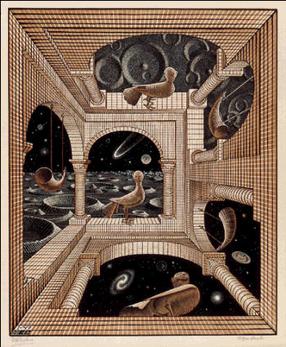
Sukkah decorations vary a lot, depending on the tastes of the owners of the sukkah. Two I have seen so far have had mirrored balls in them, ones that would look quite normal on a Christmas tree. These made me think rather of some pictures by M. C. Escher, such as this one:

I rather like the idea an Escher-inspired sukkah and based on this may eventually make a go at it myself. Though reproducing certain aspects of his work may prove challenging. I do think this image may be somewhat doable if executed correctly:
OK, off the creative goofiness and on to other things.
In the United States, one normally acquires the ’arba‘ minim (four species: palm, willow, myrtle, and citron, which get ritually waved) through a synagogue, except maybe in New York City. I expected to get them from someone sitting out front of the synagogue, as people had done before for other religious purposes, such as selling scrolls of Esther and checking tefillin. I ended up buying mine from a group who had a kid hand out advertisements. There were other such advertisements posted, and the alternative would have been to walk into Bene Beraq, where I had already seen some people trying to sell ’ethroghim (citrons) for outrageous prices. (See the Israeli movie Ha’Ushpizin, which features a 1,000 NIS ’ethrogh. None of the ones I saw were quite that expensive, but there is some truth to the premise.) The set of ’arba‘ minim I got was actually good quality, but with one flaw: usually one also receives a holder for the palm, myrtle, and willow woven out of pieces of palm frond to make the assemblage easier to handle—and somehow I did not realize I had not gotten one until too late. This does not invalidate the ritual waving in any way, but it is not ideal, and I have been practically paranoid about trying not to accidentally strip leaves off the willow and myrtle. Also, waving the four species in an apartment dominated by bookshelves (such as mine) without hitting anything is rather tricky.
In the old days, new moons were declared by a special committee, and people in the Diaspora often had to wait for days to find out when the new moon had been. As a result, many critical holidays were celebrated for an extra day due to doubt on when they actually were. When the fixed calendar was instituted—thanks to the Roman persecutions making it necessary—the extra days continued to be observed except for Yom Kippur. (The reason I was told was that people liked having an extra day off and refused to give up the extra days.) For liturgical purposes, observing the extra days can make a mess of things, as the original doubt is not implemented uniformly. Pesaḥ (Passover) and Sukkoth are divided into two parts, yom ṭov (the festival proper, on the first and last days) and ḥol hammo‘edh (intermediate days of lesser holiness). In the Diaspora, the second days of Pesaḥ and Sukkoth are treated as if they were yom ṭov in every respect, which means the technically correct prayers for ḥol hammo‘edh are not said at all. On Sukkoth specifically, things are worse. In the musaf prayer, the special sacrifices for that day are recounted, and since different sacrifices are to be brought on every single day of Sukkoth, not only are the wrong sacrifices specified for the second day, but an attempt to compensate by doubling up the sacrificial readings is made on the following days. It gets even weirder on the eighth day, the semi-independent festival of Shemini ‘Aṣereth (Eighth Day of Assembly). Unlike the last day of Pesaḥ, it does get treated a bit as doubtfully ḥol hammo‘edh, with (some) people eating and sleeping in the sukkah. However, due to the extra day added on to the holiday, there is an awkward second eighth day, which to make things a bit less confusing gets dubbed Simḥath Torah (“the joy of the Torah”) and which marks the completion of the annual cycle of reading the Torah. Here in Israel, we have none of this weirdness of extra doubtful days, and the liturgy makes a lot more sense.
I think that will be all for now. Peace.
’Aharon/Aaron


