Sunday, October 23, 2011

Harold Camping, Shemini ‘Aṣereth, and heretics who do do not know enough to copy a text straight

Jewish date:  26 Tishri 5772 (evening) (Parashath Noaḥ).

Today’s holidays:  Thirtieth Sunday of Ordinary Time (Roman Catholicism), Feast Day of St. Bobby London (Church of the SubGenius).

Greetings.

This is going to be a variety of things.

1) You may remember that Protestant minister Harold Camping predicted that the world as we know it would end on May 21, 2011 (noted in “Mark your calendars for the Rapture, but don’t hold your breath”, “The Rapture and soft maṣṣah”, and “The Rapture and Pesaḥ preparation”), which of course failed to happen.  Well, Camping came up with a new prediction after that that the world as we know it would end on October 21, 2011.  Unless this blog post is a figment of your imagination, this did not happen.  Details can be found at “Oct. 21 'Doomsday' So Far Pretty Quiet” and “Radio prophet gone from airwaves on new Judgment Day eve”.  I hope he will figure out his system does not have good predictive power and quit, but I am not that optimistic.

2) Shemini ‘Aṣereth/Simḥath Torah:  I spent a lot of Sukkoth sick and under self-imposed quarantine in my apartment.  This naturally limited what I could see people do.  I did get out before Shemini ‘Aṣereth/Simḥath Torah (I went to see a doctor and found I was not infectious), so I can report what happened then.  Simḥath Torah is distinguished by the haqqafoth ritual, in which the Torah scrolls are carried around the reading table seven times (nominally, practically much more than this) with singing and dancing to celebrate the end of the annual reading cycle and the start of the new one.  Unhappily for me, the disease I have is a respiratory infection, which made singing for me unrealistic.  Good thing that there were a lot of other people there to take care of that.  Dancing was somewhat more limited than what I am used to.  The synagogue I currently attend for Shabbath and holidays meets in trailers, as their permanent location is currently under construction; this results in crowding even under ordinary conditions.  On Simḥath Torah, this resulted in slower dancing and fewer fancy moves than there might have otherwise been in order to avoid collisions.  Haqqafofth also have a tendency to go on for extended periods of time, which prompted my synagogue to do some creative scheduling.  At night, dinner was served at the synagogue right after services, thus avoiding any delay from people having to go home and get everything ready.  In the morning, qiddush was held at the synagogue between the Torah reading and yizkor (the memorial prayer for the dead), avoiding the need for anyone to wait until a few hours into the afternoon to eat.  There is also the practice of calling up all men to read from the Torah on Simḥath Torah; at first I thought they were skipping this practice entirely, but they placed it at the very end of the services.  This is the first time I have ever heard of such a practice.  I heard mention of secondary haqqafoth being done elsewhere; even though I had not heard of that practice, due to my condition, I declined to investigate it.  Maybe next year.

I have put my willow and myrtle branches into a vase with water in the hopes of growing them.  The willow seem to have grown the beginnings of roots.  I also hope to grow trees from the seeds in my citron, but I plan to wait for it to fully ripen first.  I have no hope for growing anything from the palm frond.

This wraps it up for the Tishri holidays.  The next holiday, other than the monthly Ro’sh Ḥodhesh (new moon) is the very recent Yiṣḥaq Rabbin Memorial Day, which I am eager to find out if anyone really pays any attention to and why.  (Really.  The man committed treason by enabling the enemies of Israel and ignoring that said enemies had no real interest in making peace.  That, if anything is a reason not to dedicate a holiday to him, even if he did get assassinated.)

3) Every year, observant Jews are expected to read through the entire Torah three times, twice in the original Hebrew and once in a language they understand, usually Aramaic.  They also commonly read commentaries on the Torah as well; this year I have chosen to read the classic Hertz’s Ḥummash (Hertz, J. H., ed. The Pentateuch and Haftorahs: Hebrew Text, English Translation and Commentary. London: Defus d’universitah Oxford, 1929-1936. 2nd ed. London: Soncino Press, 1961. Print.) and, since I have this thing about religious fallacies and misinformation, a heretical (“Conservative”) commentary (Lieber, David L., and Jules. Harlow. Etz Hayim: Torah and Commentary. Travel-size ed. Philadelphia: Jewish Publication Society, 2004. Print.).  To be sure, reading a “Conservative” commentary which makes it clear in the introductions that the people who put it together do not believe in Judaism in the traditional sense of the term is annoying.  But what is more annoying than the commentary is the text of the Torah printed above the commentary.  Why?  Because they dared change the text.  I am well aware that annotations have been added to the printed text of the Torah due to the script being defective.  But the heretics decided that certain passages (Genesis 2:23; 3:14-16; 3:17-19; 4:6-7; 4:23-24; 7:11 in my reading so far, not to mention the entire hafṭarah for Parashath Bere’shith) are poetry, and so they took the liberty of taking liberties with the spacing of the text to show off the poetriness.  This is a direct violation of a great unwritten rule:

YOU WILL NOT TAMPER WITH TRADITION.

Because these idiots have reformatted the text as poetry, some reader who is not so well-informed on the history of the formatting of the Hebrew Bible may get the wrong impression that the poetic formatting is actually part of the text and impose an interpretation which may not be correct.  Good going, heretics.

Peace.

’Aharon/Aaron

Tuesday, October 18, 2011

Yom Kippur and Sukkoth

Jewish date:  20 Tishri 5772 (Parashath Bere’shith).

Today’s holidays:  Sukkoth (Judaism), Feast Day of Luke the Evangalist (Christianity), Feast Day of St. Richelieu (Church of the SubGenius).

Greetings.

This is not the best of times for me to be posting.  I have been noticeably sick (fever, coughing, questionable temperature sensations, lethargy, lack of appetite) since Saturday night.  For the sake of avoiding passing on the disease to someone else, I have stayed inside my apartment since then.  The only reason I was able to post anything on my other blog on Sunday was that I had written the post already.  I am doing better now, though still not fully recovered yet.  Being sick not been good for my Divine Misconceptions-related activities.  I had hoped to visit the Temple Mount as far back as Sunday—and have fun leading the police officer and Waqf official following me over big piles of rubble in the name of creative interpretation of civil disobedience—and at this point I do not realistically expect to be able to do so until next Sunday.  My condition has also made writing unrealistic.  (There is recent material by creationists I have felt needs criticism, and my writing the criticism is going to have to wait a while longer.)  At the moment, I do feel up to reporting a bit about Yom Kippur and Sukkoth in Israel.

Yom Kippur (the Day of Atonement):  Largely the same as Ro’sh hashShanah, except a lot of fasting.  Unlike other fast days, spending all day at home is usually not an option.  Since no one (except minors and those medically unable to fast) has any meals to go to, there is no push to keep the services short, and thus they can stretch to fill the entire day.  We only got about an hour’s break between musaf and minḥah.  It also can be very tiring.

Sukkoth (Tabernacles):  I have heard mention of the practice of starting to build the sukkah (a ritually prescribed booth to dwell in during Sukkoth) at night right after Yom Kippur.  My landlord actually did so.  There is also an older practice of using actual fruit to decorate the sukkah.  (Most people these days use plastic fruit.)  My landlord has bunches of real dates hanging in and outside of his.

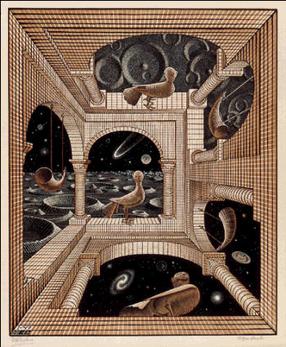
Sukkah decorations vary a lot, depending on the tastes of the owners of the sukkah.  Two I have seen so far have had mirrored balls in them, ones that would look quite normal on a Christmas tree.  These made me think rather of some pictures by M. C. Escher, such as this one:


I rather like the idea an Escher-inspired sukkah and based on this may eventually make a go at it myself.  Though reproducing certain aspects of his work may prove challenging.  I do think this image may be somewhat doable if executed correctly:


OK, off the creative goofiness and on to other things.

In the United States, one normally acquires the ’arba‘ minim (four species:  palm, willow, myrtle, and citron, which get ritually waved) through a synagogue, except maybe in New York City.  I expected to get them from someone sitting out front of the synagogue, as people had done before for other religious purposes, such as selling scrolls of Esther and checking tefillin.  I ended up buying mine from a group who had a kid hand out advertisements.  There were other such advertisements posted, and the alternative would have been to walk into Bene Beraq, where I had already seen some people trying to sell ’ethroghim (citrons) for outrageous prices.  (See the Israeli movie Ha’Ushpizin, which features a 1,000 NIS ’ethrogh.  None of the ones I saw were quite that expensive, but there is some truth to the premise.)  The set of ’arba‘ minim I got was actually good quality, but with one flaw:  usually one also receives a holder for the palm, myrtle, and willow woven out of pieces of palm frond to make the assemblage easier to handle—and somehow I did not realize I had not gotten one until too late.  This does not invalidate the ritual waving in any way, but it is not ideal, and I have been practically paranoid about trying not to accidentally strip leaves off the willow and myrtle.  Also, waving the four species in an apartment dominated by bookshelves (such as mine) without hitting anything is rather tricky.

In the old days, new moons were declared by a special committee, and people in the Diaspora often had to wait for days to find out when the new moon had been.  As a result, many critical holidays were celebrated for an extra day due to doubt on when they actually were.  When the fixed calendar was instituted—thanks to the Roman persecutions making it necessary—the extra days continued to be observed except for Yom Kippur.  (The reason I was told was that people liked having an extra day off and refused to give up the extra days.)  For liturgical purposes, observing the extra days can make a mess of things, as the original doubt is not implemented uniformly.  Pesaḥ (Passover) and Sukkoth are divided into two parts, yom ṭov (the festival proper, on the first and last days) and ḥol hammo‘edh (intermediate days of lesser holiness).  In the Diaspora, the second days of Pesaḥ and Sukkoth are treated as if they were yom ṭov in every respect, which means the technically correct prayers for ḥol hammo‘edh are not said at all.  On Sukkoth specifically, things are worse.  In the musaf prayer, the special sacrifices for that day are recounted, and since different sacrifices are to be brought on every single day of Sukkoth, not only are the wrong sacrifices specified for the second day, but an attempt to compensate by doubling up the sacrificial readings is made on the following days.  It gets even weirder on the eighth day, the semi-independent festival of Shemini ‘Aṣereth (Eighth Day of Assembly).  Unlike the last day of Pesaḥ, it does get treated a bit as doubtfully ḥol hammo‘edh, with (some) people eating and sleeping in the sukkah.  However, due to the extra day added on to the holiday, there is an awkward second eighth day, which to make things a bit less confusing gets dubbed Simḥath Torah (“the joy of the Torah”) and which marks the completion of the annual cycle of reading the Torah.  Here in Israel, we have none of this weirdness of extra doubtful days, and the liturgy makes a lot more sense.

I think that will be all for now.  Peace.

’Aharon/Aaron

Tuesday, October 4, 2011

Seliḥoth, Ro’sh hashShanah, and Fast of Gedhalyah

Jewish date:  7 Tishri 5772 (evening).

Today’s holidays:  The Ten Days of Repentance (Judaism), Feast Day of Francis of Assisi (Roman Catholicism), Feast Day of St. Buster Keaton (Church of the SubGenius).


Greetings.

It has been too long since I last posted.  For one thing, I have been busy with work, trying to get a paper to first draft stage, which helped tire me out.  For another, the previous month on the Jewish calendar, ’Elul, and the current one, Tishri, are themselves very good for tiring people out.  ’Elul is the season to prepare for Tishri and hence given over for repentance.  ’Elul also has a set of penitential prayers known as seliḥoth which are said either late at night or early in the morning.  How long selihḥoth are said varies by ethnic group; Sefaradhim (Jews whose ancestors lived in Spain and Portugal) and ‘Edhuth hamMizraḥ (Middle Eastern Jews) say seliḥoth all of ’Elul, while ’Ashkenazim (Mid- and Eastern European Jews) (such as myself) begin the week before Ro’sh hashShanah.  Even though, seliḥoth do not do a lot of good for getting a good night’s sleep.  And this problem has not ended yet, since seliḥoth are said until Yom Kippur.  So I am feeling somewhat zombie-like and expect to be this way for the rest of the week.  (Yom Kippur is this Saturday.)

OK, let’s try to say something meaningful about ’Elul and Tishri in Israel.  I hope this turns out somewhat intelligible, but considering my condition, if anyone needs translation or further explanation, feel free to ask.

Seliḥoth:  I pray according to the Lithuanian rite, or more precisely, (largely) according to the rite of the Ga’on Rav ’Eliyyahu of Vilna.  The synagogue I pray morning services at during the week does seliḥoth according to the Polish rite.  Ordinarily variations in ’Ashkenazi rites are not large, but the people in Poland included a somewhat different set of liturgical poetry among the seliḥoth, enough that I have found myself losing track of where we were in those early morning prayers.

Advertising:  Muted, as all the Jewish holiday advertising I have seen already.

Ro’sh hashShanah:  On Shabbath and major holidays, I pray in a synagogue known for two things:  1) a musical style of prayer pioneered by Rav Shelomoh Carlebach, taken to the point where I have compared praying there to being in a musical, and 2) being crowded on Shabbath and major holidays.  (People who come late have to stand for the entire service).  Ro’sh hashShanah prayers everywhere tend to be more musical than normal, so there the difference was not so great.  The level of crowding, which everywhere tends to be bad on Ro’sh hashShanah, was worse than normal, with extremely little space available even for people willing to stand the entire service.  I sat in the back next to the partition between the men and women’s sections, and I was pressed for space enough that my left shoulder hurt.  During the musaf service, when we are supposed to prostrate ourselves on the floor, I only had room to crouch.

There are a lot of nice people in the community, and a local rav usually arranges for places for me to eat on Shabbath and major holidays.  (I am relatively new here, single, and without family in the area.  Eating alone on holy days is not ideal or fun.)  At dinner on Ro’sh hashShanah symbolic foods are eaten; this is a sort of prayer through action, though the symbolism is often based on puns which are quite untranslatable.  One of the more translatable symbolic foods is the eating of the head of a fish or mammal.  (“May it be Your will, YHWH our god and god of our ancestors, that we be to the head and not to the tail.”)  Among various other symbolic foods, on the first night we were actually served a fish head.  I found it too repulsive to eat any of it.  (And I watched a sheep get slaughtered without fainting or reverse peristalsis.  Go figure.)  Though I have often heard about the custom of eating a head on Ro’sh hashShanah, this is only the second time I have actually seen it practiced.  (The first time was years ago at Yeshiva University, where someone in the cafeteria had somehow gotten his hands on half of a sheep skull with some meat still on it.)

Another symbolic food, one much more commonly consumed, is pomegranate seeds.  (“May it be Your will, YHWH our god and god of our ancestors, that we be as full of miṣwoth as a pomegranate.”)  On the second night of Ro’sh hashShanah, I was at a communal dinner, and a number of the participants brought pomegranate seeds.  While many of these came from pomegranates purchased intact, there was also there a packet of pomegranate seeds without the rest of pomegranate around them.  This, I presume, was an attempt by someone to make a quick buck (or in this case, a quick sheqel) from people who are too lazy to remove the seeds from a pomegranate themselves.  I would like to note that as far as harnessing laziness for profit goes, this was a failure.  The pomegranate seeds which came packaged inside a pomegranate tasted better than the ones packaged in plastic.  The inclusion on a small black plastic spork with the pomegranateless pomegranate seeds, presumably to get them out of the package, did absolutely nothing to improve the taste or their convenience.

The Fast of Gedhalyah:  Nothing particularly unusual.  Then again, I spent most of the day in my apartment to avoid overheating.

Rain:  The Jewish liturgy includes praying for rain in the winter, but not in the summer.  This accurately reflects the climate in Israel.  We have not had rain all summer, and only recently did we get any again.

I think that’s about all I can produce right now.  Oh, and in the spirit of the season, I extend forgiveness for all those who have inadvertently sinned against me.

May you all be written for a sweet year.

’Aharon/Aaron

Friday, September 9, 2011

“Reversing the Moral Decay Behind the London Riots”

Jewish date:  10 ’Elul 5771 (Parashath Ki Theṣe’).

Today’s holidays:  Feast Day of Peter Claver (Roman Catholicism), Feast Day of St. Dean Corll (Church of the SubGenius).

Greetings.

Recently Harold sent me a link to an article worth mentioning, “Reversing the Moral Decay Behind the London Riots” by Rav Jonathan Sacks, which deals with the decline of morality (as an extension of religion) starting in the 1960s in the United Kingdom and the West in general as a factor leading to the recent London riots.  And I do think that he has a point.  Human societies are governed by rules, and a what we do is influenced by what we see others do.  When people jettison rules which exist for perfectly good reasons (like rules against selfishness), bad consequences are unsurprising.

Clearly things have changed since the 1960s.  Very apparent is that there have been changes in what is considered acceptable in the media.  For a humorous example, if you will recall the 1960s sit-com Gilligan’s Island, it was followed up in 1978 with Rescue from Gilligan’s Island, which brings the castaways back to civilization after 15 years of isolation; of all the characters, it is Ginger, the sex symbol of the series, who criticizes many of the movies of that time for gratuitous sex and foul language.  I am well aware that things have not gotten better in this regard since 1978.  In fact, a lot of stuff I watch these days (over the Internet) is decades old, not merely out of curiosity of things I have only heard about or nostalgia, but also because of content.  If Gilligan’s Island were made today—and there have been repeated threats of a movie version from time to time—it would almost certainly be a very different show; there is a high probability there would be a good deal of that gratuitous sex that Ginger complained about (certainly something beyond the teasing and manipulation that Ginger actually did), quite likely some foul language, probably more infighting and a good deal less of a sense of community, and probably more violence than the Skipper hitting Gilligan with his hat.

On the other hand, I find myself wondering how much of a trend of moral decay there really is.  Human society consists of billions of people, and thus lots of different trends can happen simultaneously in all sorts of directions.  And I do not think things have been going down uniformly.  For example, there has been a lot of emphasis placed on eliminating racism and creating a more just world starting in the 1960s.  I have also heard that Judaism was largely dying out in the United States until 1948, after which there has been an increasing ba‘al teshuvah movement (to put it in Christian terms, Jews “getting religion”).  To Rav Sacks’s credit, he avoids the clichéd falsehood that moral decline is inevitable and even notes that in the 1820s that the United States and Britain became more religious.

Paradoxically, you can even get things going both ways at the same time in the same group of people.  The United States has a large population of religious Christians—many of which politically take positions which are difficult or impossible to reconcile with anything Jesus taught.  (Republicans, take heed.  This means you.  I am no fan of Jesus, but I know full well that “kick the poor when they’re down” is the exact opposite of what he preached.)  Go figure.

Peace and Shabbath shalom.

’Aharon/Aaron

Tuesday, August 30, 2011

Only in Israel: a public sheḥiṭah demonstration

Jewish date:  30 ’Av 5771 (Parashath Shofeṭim).

Today’s holidays:  Ro’sh Ḥodhesh ’Elul (Judaism), Tuesday of the Twenty-Second Week of Ordinary Time (Roman Catholicism), Chaand Raat (Islam), Feast Day of St. Thor (Church of the SubGenius).

Greetings.

Yesterday, thanks to a friend, I attended a demonstration of sheḥiṭah (AKA kasher ritual slaughter) in Petaḥ Tiqwah (the next town east of here).  Two chickens and a sheep were killed, and a few tens of people got to see what the inside of a sheep looks like.  This was very educational for anyone who wants to know about sheḥiṭah and related ritual phenomena, such as what fat counts as ḥelev (which is forbidden for consumption) and shumman (which is permitted), what portions should be given to a kohen (priest), and gidh hannasheh (the sciatic nerve, which is forbidden for consumption).  I did not take pictures, and if I did, I probably would not post them anyway.  The demonstration was worthwhile attending, but it was only for people with strong stomachs.

What I found very interesting was not so much the demonstration itself, but the circumstances:
  • Attending were not just men, but also women and children, neither of which normally perform sheḥiṭah.
  • No one fainted or vomited.  My friend told me that some children cried, though I did not notice them at all.  In fact, many children stood close to better see the sheep cut up.
  • The demonstration was performed in the front yard of a synagogue, in easy view of the street.
  • There were no protesters, despite the demonstration being publicly advertised in advance.
Now, try to imagine what would have happened had anyone tried holding such a demonstration in the United States.  In the United States, animal slaughter in public is practically taboo and almost never heard of.  I have heard of Santeríans being harassed, in violation of the US Constitution, for performing animal sacrifice.  Had this demonstration been done in the United States, I would have expected People for the Ethical Treatment of Animals to complain bitterly.  Here in Israel, it was an inoffensive curiosity. I am not clear why this cultural difference exists.  I have to remember to start asking about attitudes to animal slaughter in Israel and how common public animal slaughter is over here.

While I am posting, a few other items of interest:
Peace.

’Aharon/Aaron

Thursday, August 25, 2011

Dishonest reporting

Jewish date:  26 ’Av 5771 (evening) (Parashath Re’eh).

Today’s holidays:  Feast Day of Louis of France and Joseph Calasanz (Roman Catholicism), Feast Day of St. Heliogabulus (Church of the SubGenius), Feast Day of Friederich Nietzsche (Thelema).


Greetings.

Recently I came across a short article which struck me as off, and Barry independently asked me to comment on it.  The article is “Rabbis Help Gays Find Sexless Marriages To Procreate For God”.

It starts with this:
Ever wish that you could have a sexless marriage, lots of affairs, and still have the approval of God?  Well, now you can, if you are a homosexual Jew — as long as you promise to procreate in the name of the Lord as well.
It was immediately obvious that something was wrong.  Judaism does not condone affairs by anyone, whether they are heterosexual or homosexual, and making children does not excuse such misbehavior.  The rest of the article was also suspicious:
Via Think Progress:
A new Orthodox Jewish service “seeks to help religious homosexuals and lesbians find a partner for procreation purposes – as long as they promise to try to change their sexual orientation,” YNet News reports. An orthodox interpretation of Jewish law forbids homosexual relations, but the match-making website hopes to connect men and women “seeking to start a family in Israel, even without sexual attraction, in order to bring religious children into the world and provide them with traditional education. Thus, a religious gay man will be able to meet a religious lesbian woman through the website and have children with her.”
It’s assumed, of course, that any gay person involved in this sort of arrangement will be having affairs, and according to the service that’s just fine — it’s not cheating if you’re both doing it and your partner knows and approves.  After all, it’s all worth it if it makes more children of the faith.  And the Rabbis themselves believe they are acting under the best of intentions. “Almost everyone understands that there are those who simply cannot change,” [Orthodox Rabbi Arale] Harel admits. “This initiative was designed for them.” 
Still, it’s funny to think, so many religious people are worried that same sex marriage is destroying the “traditional” definition of marriage.
Now, I had already heard about Rav Har’el matchmaking homosexuals (of the opposite sex).  (See “Orthodox Gay Marriage” and “Israeli rabbis launch initiative to marry gay men to lesbian women”.)  However, I had not heard anything about him approving affairs, and when one also takes into account the flippant tone of this article, my suspicions were raised that whoever wrote it did not bother to do any research.

So let us follow the links.  This article refers back to another article in ThinkProgress, “RABBIS MATCH GAYS AND LESBIANS ‘TO BRING RELIGIOUS CHILDREN INTO THE WORLD’”, which was quoted almost in its entirety.  The only part which was not quoted is:
“We are aware of the fact that the man and woman may have extramarital relations according to their sexual inclination, but at least they won’t be cheating on their partners, as it will be done with their consent,” one Orthodox rabbi explained
So far we are still in the midst of suspicious content.  The second article links to a third article on Ynetnews, “Rabbis to match homosexuals, lesbians”:
A new Web initiative seeks to help religious homosexuals and lesbians find a partner for procreation purposes – as long as they promise to try to change their sexual orientation.

Currently, religious gay people are not entitled to use the sector's regular matchmaking service. In the coming days, the Kamoha website for Orthodox homosexuals will introduce a new page resembling leading dating websites. But unlike similar initiatives which have failed in the past, this one enjoys the support of senior Religious Zionism rabbis.

As Jewish Halacha forbids homosexual relations, the initiative will connect between men and women seeking to start a family in Israel, even without sexual attraction, in order to bring religious children into the world and provide them with traditional education. Thus, a religious gay man will be able to meet a religious lesbian woman through the website and have children with her.

The initiative is being led by Orthodox Rabbi Arale Harel, former head of the Shilo hesder yeshiva. According to Harel, the program has the support of additional Religious Zionism rabbis, including Haim Drukman, Yaakov Ariel and Elyakim Levanon.

Harel says he has so far matched more than 10 gay-lesbian couples, and is now seeking to institutionalize the issue.

"There is no rabbi who will approve such a marriage," he explains. "We are aware of the fact that the man and woman may have extramarital relations according to their sexual inclination, but at least they won't be cheating on their partners, as it will be done with their consent."

Nonetheless, Harel has added a condition for the match, which may deter religious homosexuals and lesbians. According to the rabbi, the couple will first have to undergo "psychological conversion therapy aimed at helping the patients change their sexual inclination."

Those seeking to use the website's services will undergo a screening process, and after paying NIS 150 (about $42) in order to prove that they are serious about the issue, they will be able to go out with members of the opposite sex while receiving psychological and rabbinical advice.

"Almost everyone understands that there are those who simply cannot change," Harel admits. "This initiative was designed for them."
This article adds new, unusual details.  First of all, there is the listed requirement of conversion therapy.  Conversion therapy, which aims to change homosexuals into heterosexuals, is not scientifically recognized as actually working and may be harmful.  This requirement is paradoxical, considering that Rav Harel claims that some people cannot change their sexual orientation.  Secondly, there is the obvious contradiction between this matchmaking having rabbinical approval and the claim that no rabbi would approve of such a match.  Also unusual is what is omitted:  a link to this “new Web initiative”.

Given the difficult nature of these three articles, I decided to find Rav Har’el and company and see what they have to say for themselves.  And I did find them.  Their site is Kamokha and their new initiative is ’Anaḥnu.  From the three questionable articles, one might think that rabbis, especially Rav Har’el, were going out their way to get homosexuals to marry people of the opposite sex.  They are not.  Kamokha is an organization of Orthodox Jewish homosexual men who wish to live by Orthodox Judaism.  This includes the prohibition on the practice of homosexuality.  If this seems strange to anyone, do note that just because one has a desire to do something does not mean one will actually do it or even wants to have this desire.  ’Anaḥnu is also their initiative; please note that homosexuals, like heterosexuals, often want to get married and have children.  Kamokha approached Rav Har’el to establish this program.  This is something they want, not something anyone is trying to foist upon anyone else.  They also make it clear that this program is experimental, that it is only for those who have come to terms with not being able to change their sexual orientation, and that this is not a program meant to change sexual orientation.  There is no requirement of conversion therapy whatsoever.  Neither is there any permission for affairs.  To put it bluntly, the people behind the questionable articles lied.  At the most generous, one might think they confounded ’Anaḥnu with another Kamokha initiative, one to provide conversion therapy for free for those who want it—with full recognition that it is controversial—but that would be difficult to do accidentally without being amazingly stupid.

As for the whole business of affairs being allegedly OK for married homosexuals, that may be a perversion of something that Rav Har’el said in an interview pulled out of context:
"Most of the couples agree not to have relationships with members of their own sex, but if there are 'lapses' once every few years, they don't see this as a betrayal," he said. "Generally, it's between them and their Creator."
This is not permission to have an affair by any means, only a statement on the psychology and theology.

Sadly, this display of dishonesty is precedented.  (E.g., see my reviews of His Dark Materials, The God Delusion, Religulous, Expelled:  No Intelligence Allowed, and Godless:  The Church of Liberalism.)  If one wishes to argue that homosexuals should never marry anyone of the opposite sex, fine.  If one wishes to argue that homosexuals should not resist their sexual desires but instead rejoice in them, fine.  If one wishes to argue that homosexuals should never have children, fine.  If one wishes to argue that no one should ever aid and abet a homosexual in marrying someone of the opposite sex and producing children, even if that is what the homosexual wants, fine.  Argue any position you want, but do it on the basis of the actual facts.  If someone has to lie or quote out of context to “prove” that someone is doing something wrong, then that person has given the perfect reason to believe that nothing wrong is being done.  And this goes double when the result is mockery and not even a pathetic excuse for an argument.  Practically anyone can do better than this.

Peace.

’Aharon/Aaron

Tuesday, August 23, 2011

Ezekiel 4:9 is not about health food

Jewish date:  23 ’Av 5771 (Parashath Re’eh).

Today’s holidays:  Feast Day of Rose of Lima (Roman Catholicism), Nuclear Accident Day (Church of the SubGenius).

Greetings.

A while ago, Barry sent me some pictures of some unusual bread and asked me to post on it.  Unfortunately, Blogger is not being cooperative about loading pictures, so instead I am going to direct you towards the Web-site for the bread:  Ezekiel 4:9® | Food For Life.  Thus is it written in Ezekiel 4:9 (my translation):
And you, take for yourself wheat and barley and beans and lentils and millet and spelt, and you will put them in one vessel, and you will make them for yourself into bread; [for] the number of days that you are lying on your side, 390 days, you will eat it.
The people making bread based on this seem to be taking it as a recipe for health food, claiming “This Biblical Bread is Truly the Staff of Life”.

Now, as an epidemiologist and thus someone who has been exposed to a good deal of health-related information, I am all for variety in one’s diet.  However, healthy eating is not what this verse is about.  Let us consider the context of this verse.  Yeḥezqe’l (Ezekiel) was living at the end of the First Temple Period.  When he prophesied, he was on the shore of the Kevar in Babylonia, as he had already been exiled.  Yeḥezqe’l’s prophecies deal with the transgressions (severe enough to cause major social problems) that ultimately led to the destruction of the First Temple, the 70 years of exile, and the eventual  return of the Jewish people and rebuilding of the Temple.  In publicizing these prophecies, YHWH instructed Yeḥezqe’el to act in some truly bizarre ways, thus getting people’s attention.  Ezekiel 4:9 is part of a set of instructions that Yeḥezqe’l is to lay siege on a brick and spend over a year lying on his side.  The recipe is representative of what people eat in times of siege; not being able to freely import food, they eat whatever they have available, even if it turns out to be unusual mixture.  Please note that Yeḥezqe’l is supposed to ration his food and water during this time (Ezekiel 4:10-11), and what he is supposed to use as fuel for cooking his food is something that no one with any sense (of hygiene, at least) would use unless they had no other choice (Ezekiel 4:12, 4:16).  (I presume the Food and Drug Administration does not permit that level of authenticity.)  Taking the recipe as being meant as health food is nothing less than a gross violation of context.

Even more far-fetched is their Genesis 1:29® sprouted grain and seed bread.  Thus is it written in Genesis 1:29 (my translation):
’Elohim said, “Behold, I have given you every herb bearing see that is on the face of all the Earth and every tree that on it is the fruit of the tree bearing seed; for you it will be for food.”
This verse is talking about plants in general as food, but somehow the Food for Life people have taken it as inspiring bread made with 19 different plant-based items from around the planet.  Note that at no point does this verse talk about any form of cooking or even of mixing different ingredients.  I have no idea what these people are thinking.

Theological rating for these products:  F.

Peace.

’Aharon/Aaron